

Evaporative cooling, also known as adiabatic cooling, is a natural climate control technology that is becoming increasingly popular for cooling medium-sized and large buildings.
This system is based on a simple physical principle that has been known for centuries: the evaporation of water to reduce air temperature.
Rudimentary versions of this method were already used in ancient times, but the advent of modern technology has enabled evaporative cooling to be used in increasingly advanced and efficient applications.
Thanks to innovative materials, precision electronics and optimised design, this principle can now be used for climate control in spaces with minimal energy consumption. Evaporative cooling appliances do not require refrigerants, but instead use a simple fan and pump to circulate water. The result is "natural", sustainable cooling with a reduced environmental impact and extremely low operating costs. This makes them an ideal solution for anyone seeking an effective and environmentally friendly climate control system.
What evaporative cooling is and how it works - a brief explanation
Evaporative, or adiabatic, cooling is a simple and natural way to provide climate control in indoor spaces by using a familiar physical principle: evaporation. When water evaporates, it absorbs heat from the surrounding air, reducing its temperature.
But how exactly does it work? Imagine a cool breeze on a hot day: evaporative cooling reproduces the same effect using a device that:
- draws in outdoor air using fans;
- passes the air through special water-saturated pads;
- supplies cool, humidified air to the indoor spaces.
It is particularly effective in hot, dry areas, where the air can readily absorb water vapour. The result is cooler, more comfortable indoor spaces, without the need for refrigerant gases or high energy consumption.
The following sections provide full technical details and explain every aspect of evaporative cooling, including why it is so sustainable.
Advantages of evaporative coolers
Evaporative coolers offer a number of advantages that make them an attractive choice for anyone seeking an effective and sustainable way to provide climate control in industrial or commercial spaces. The main benefits are:
- low energy consumption;
- no use of harmful refrigerant gases;
- low cost and simple installation;
- improved air quality.
Low energy consumption
One of the main strengths of these systems is their exceptional efficiency. Evaporative coolers consume very little energy, requiring only enough to power the fans and water pumps. Compared with conventional air-conditioning systems, they provide significant energy savings, reducing both energy bills and environmental impact.
No use of refrigerant gases
Unlike conventional air-conditioning systems, evaporative coolers do not use refrigerant gases, which are often harmful to the environment. This means that indoor spaces can be cooled entirely naturally, without pollutant emissions.
Low cost
The installation of an evaporative cooler is simple and does not require particularly costly work. Maintenance requirements are also minimal, making these appliances an ideal solution for anyone seeking a cost-effective alternative without compromising comfort.
Improved air quality
In addition to providing cooling, these systems improve the air we breathe. The air supplied to the indoor spaces is filtered and cooled, reducing dust and harmful particles. This benefits not only comfort, but also health.
Thanks to these advantages, evaporative coolers provide a versatile, sustainable and efficient way to manage high temperatures effectively.
Disadvantages of evaporative coolers
Like any technology, evaporative coolers also have certain limitations that must be taken into account. The main disadvantages are:
- limited efficiency in humid climates;
- increased indoor humidity;
- the need for continuous air changes;
- performance that varies according to weather conditions.
Limited efficiency in humid climates
In environments with high humidity levels, the effectiveness of evaporative cooling decreases, as the air is already saturated with water vapour and cannot absorb any more.
Increased indoor humidity
The cooled air supplied to the indoor spaces increases the relative humidity, which may reduce perceived comfort in some cases, particularly if adequate air changes are not ensured.
Need for continuous air changes
To maintain system efficiency, it is essential to ensure a continuous air change by using open doors or mechanical extract fans.
Variable performance
The cooling achieved depends closely on outdoor weather conditions, such as temperature and relative humidity, and may not meet requirements on particularly hot and humid days.
Evaporative cooling - a technical and scientific explanation
The following sections take a closer look at this technology.
Operating principle of an evaporative cooler
Evaporative cooling makes use of one of the physical properties of air, which, as is well known, can absorb and therefore hold a certain amount of water vapour depending on its temperature. The ratio between the actual amount of water vapour present in the air at a given moment and the maximum amount it can hold defines the air's relative humidity (RH), expressed as a percentage.
Evaporative cooling makes it possible to add to the air the amount of water vapour required to bring it to saturation (or close to saturation), i.e. to a relative humidity approaching 100%. If a volume of air has a low relative humidity (RH), it means that, when suitably treated, it can absorb additional moisture until it reaches approximately 90-95% RH. The absorption of water vapour by the air is made possible by the heat contained within the air itself, which provides the energy required to evaporate a certain quantity of water, converting it into water vapour. This "evaporation" heat is extracted from the air itself, which therefore increases its relative humidity while simultaneously losing part of its heat, resulting in a reduction in air temperature.
The drier the air, the more water vapour it can absorb, whereas the more humid it is, the less additional moisture it can take up. Furthermore, the absolute amount of water vapour that air can contain depends on its temperature: the warmer the air, the greater its capacity to hold water vapour, and vice versa. This physical property of air is clearly illustrated by the psychrometric chart (Fig. 1), which shows the various conditions and characteristics of humid air.
The air conditions that enable it to absorb the greatest quantity of water vapour are those furthest from the saturation region (the area without curves in the upper left-hand part of the chart), namely those with the lowest relative humidity (represented by the lower curves on the chart) and the highest temperature (represented on the right-hand side of the chart).
The thermodynamic transformation undergone by the air during evaporative cooling can be regarded as an isenthalpic process, i.e. a process in which the enthalpy of the air remains constant. By definition, this process takes place without any direct exchange of work or heat with the surrounding environment, hence the term adiabatic cooling.
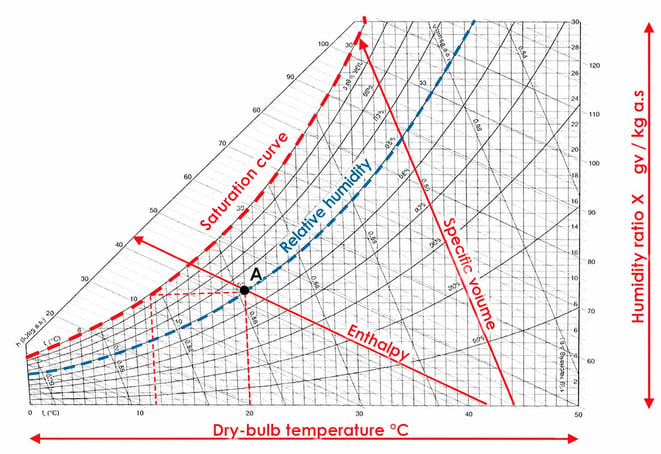
Fig. 1 - Psychrometric chart of humid air - Isenthalpic process
The process is characterised by a reduction in sensible heat (a decrease in air temperature) offset by an increase in latent heat (an increase in the water vapour content), as shown by the plot on the psychrometric chart below (Fig. 2).
In summary, during the evaporative cooling process the incoming air (point A in Fig. 2) is humidified (point B) and simultaneously cooled (point C), changing from conditions of RH = 50% and Temperature = 35°C to RH = 88% and Temperature = 27°C.
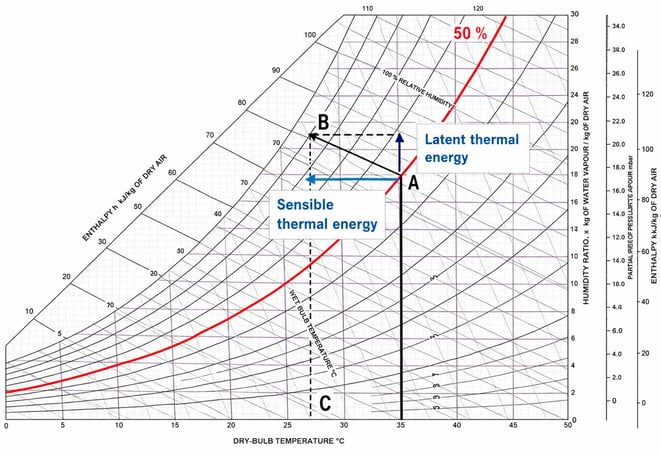
Fig. 2 - Psychrometric chart of humid air - outdoor air entering at 35°C and 50% RH (point A) - humidification to 90% RH (point B) with cooling to 27°C.
Evaporative cooling appliances are designed to make the best possible use of this principle: cooling outdoor air by humidifying it and then supplying it into the building, where occupants perceive a flow of air that is cooler than the outdoor air to a greater or lesser extent, depending on the outdoor air temperature and humidity (Fig. 3).
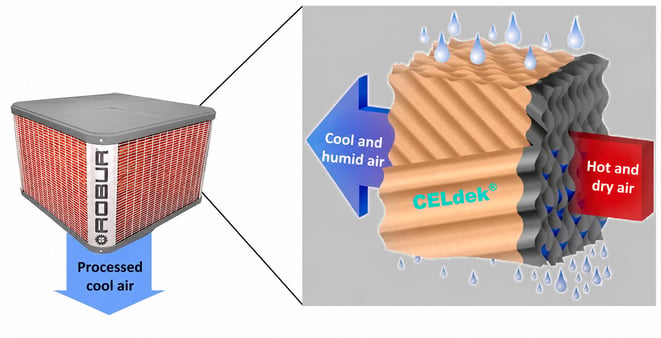
Fig. 3 - Operating principle of an evaporative cooler
System efficiency
The cooling effect that can be achieved cannot be compared with that of a "traditional" air-conditioning system, where cooling is produced by equipment using a refrigerant circulating in a closed or hermetically sealed circuit. As explained above, the cooling performance achieved depends largely on:
- the outdoor air temperature and relative humidity (RH), as this is the air that is treated and supplied into the building;
- the saturation efficiency of the evaporative cooler. The higher the saturation efficiency, the lower the temperature of the air delivered by the appliance to the space being cooled.
The table in Fig. 4 shows the outlet air temperature delivered by the Robur AD evaporative cooler under different outdoor air temperature and humidity conditions.
As can be seen, the lower the temperature - and above all the relative humidity - of the incoming air, the lower the outlet air temperature that can be achieved.
| Outdoor air temperature | Outdoor air humidity | ||||||
| 20% | 30% | 40% | 50% | 60% | 70% | 80% | |
| 25°C | 13.7 | 15.4 | 17.0 | 18.6 | 20.0 | 21.3 | 22.6 |
| 30°C | 17.0 | 19.1 | 21.0 | 22.8 | 24.4 | 26.0 | 27.4 |
| 35°C | 20.4 | 22.9 | 25.1 | 27.1 | 29.0 | 30.6 | 32.1 |
| 40°C | 23.0 | 26.0 | 29.0 | 31.5 | 33.5 | 36.5 | 38.0 |
Fig. 4 - Cooler outlet air temperature as a function of the incoming outdoor air conditions
The air-to-water heat exchange system used in these appliances consists of 100 mm thick high-efficiency evaporative pads, providing a saturation efficiency of approximately 85-90%.
These pads are made from cellulose sheets coated with a protective layer that ensures long service life, allows outdoor installation with direct UV exposure, and prevents deterioration caused by continuous contact with water.
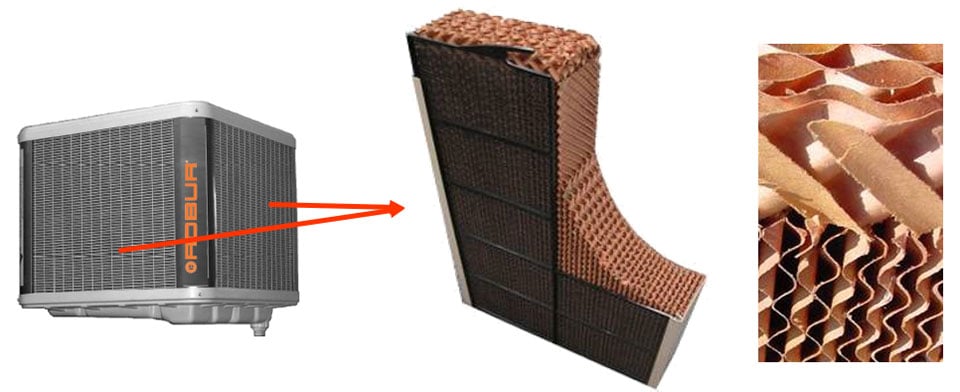
Fig. 5 - Cellulose evaporative pads
But what indoor temperature can be achieved if the outlet air temperature from the appliance is known?
To answer this question, it is first necessary to know the specified air change rate. As previously explained, the evaporative cooler continuously draws in a given volume of outdoor air (13,000 m3/h in the case of the Robur AD14 model), cools it to a temperature that can be determined from the table in Fig. 4, and supplies it into the building. Design air change rates are normally no lower than 10-15 air changes per hour, so it can reasonably be assumed that the indoor air temperature will be no more than approximately 2-3°C higher than the supply air temperature. It should be emphasised that this effect can only be achieved if adequate air changes are ensured within the building, meaning that the incoming air must be continuously extracted or discharged from the building. In other words, the building must be able to continuously remove the air supplied by the evaporative coolers, either naturally (through permanently open doors, gates and windows) or mechanically (by means of appropriately sized extract fans).
But how can we deal with high temperatures, and especially the oppressive summer humidity that makes certain days particularly uncomfortable, given that the system becomes less efficient at high humidity levels?
Before answering this question, it is useful to consider one important point: as air temperature increases, its relative humidity (RH) generally decreases because warmer air has a greater capacity to absorb water vapour (as illustrated in the psychrometric chart in Fig. 1). Consequently, the lowest RH values normally occur during the hottest hours of the day. This is confirmed by Fig. 6, which shows the temperature and relative humidity trends recorded in the Milan area during July 2018.
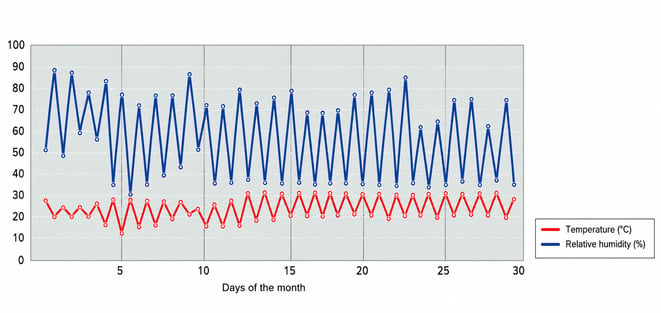
Fig. 6 - Air temperature and humidity trends in Milan, July 2018.
Nevertheless, some days can still be particularly hot and humid. It should also be borne in mind that an evaporative cooling system increases the humidity level of the indoor air, which may raise questions about the actual comfort that can be achieved. To understand this, another chart, shown in Fig. 7, is particularly useful.
This chart illustrates the concept of "apparent temperature" by correlating air temperature and relative humidity. Widely used by weather services during the summer months, this concept shows how the combination of air temperature and relative humidity creates a perceived temperature that is higher than the actual air temperature. The higher the humidity, the higher the apparent temperature.
The chart also highlights another important point: as the air temperature decreases, the influence of humidity on perceived comfort also decreases. For example, increasing the relative humidity from 30% to 60% at 33°C raises the apparent temperature by 8°C (from 32°C to 40°C). However, when the air temperature is around 29°C, the same increase in relative humidity raises the apparent temperature by only 3°C (from 28°C to 31°C).
In this context, the performance of the evaporative cooler should be assessed accordingly: if the appliance is capable of supplying air to the indoor space at a temperature below 27-28°C, the increase in humidity generated by the evaporative cooler becomes virtually negligible in terms of occupant comfort.
It should also be remembered that during cool spring and autumn days, relative humidity can be very high, yet this has little impact on perceived comfort because of the lower air temperature.
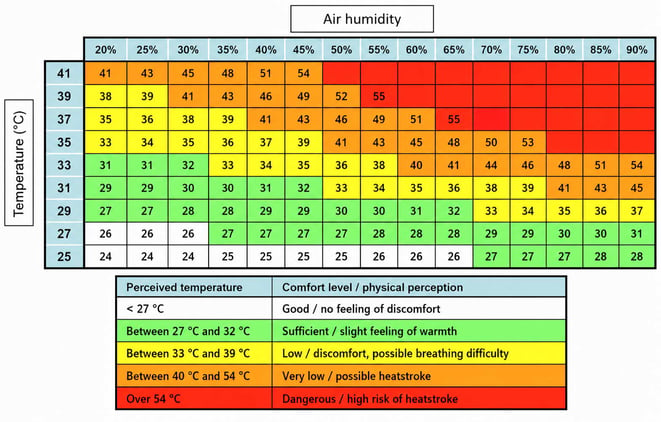
Fig. 7 - Stedman Heat Index chart. Shows the apparent temperature as a function of air temperature and relative humidity.
But what happens during the few, yet particularly uncomfortable, hot and humid days?
If the air humidity is particularly high, the system becomes less efficient. However, referring once again to the chart in Fig. 6, it is easy to see that even under these conditions, reducing the supply air temperature by only a few degrees significantly lowers the apparent temperature. For example, at an air temperature of 33°C and a relative humidity of 70%, the apparent temperature is equivalent to 44°C. Reducing the air temperature by just 2°C, while maintaining the same humidity level, lowers the apparent temperature by as much as 6°C.
System hygiene
An evaporative cooler uses water (a portion of which evaporates during operation) to cool a flow of air. To ensure consistently high standards of hygiene, evaporative coolers incorporate a range of technical and electronic features. Modern, high-performance evaporative coolers, such as the Robur AD14, are equipped with a microprocessor-based electronic control board that manages water filling and draining, prevents water stagnation in the tank when the appliance is switched off, limits excessive limescale concentration in the recirculating water, and automatically cleans the cellulose evaporative pads through scheduled self-washing cycles at regular intervals.
The system is completed by washable filters at the air inlet, preventing dirt from accumulating on the evaporative pads.
Installation
Installing evaporative coolers is straightforward. The appliances can be roof-mounted (the most common solution, shown in the installation example in Fig. 8) or wall-mounted. In either case, they must be connected to ductwork that conveys the outdoor air, cooled by the evaporative pads, into the building. The ductwork can be designed in different shapes and lengths to suit the building requirements, taking advantage of the fan's available external static pressure of approximately 80 Pa.
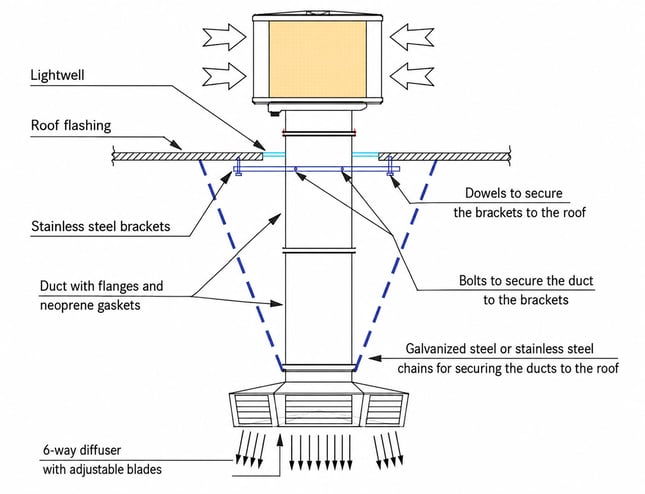
Fig. 8 - Example of a roof-mounted installation with vertical ductwork
For operation, the appliance requires a water supply connection and a 230 V AC electrical power supply. The water connection is made permanently using the flexible hose supplied with the appliance. The electronic controller automatically manages water filling and top-up according to the actual evaporation rate. It also drains the concentrated residual water only when necessary to limit limescale build-up. The electrical power required to operate the small water circulation pump and the fan is supplied from a single-phase 230 V AC power supply, thanks to the appliance's low power consumption.
Installation requires nothing more than fitting the remote controller, supplied according to the selected model, which enables system start-up and, where applicable, remote control and adjustment. The Robur AD evaporative cooler can also be controlled by a timer, a room thermostat and a humidistat for monitoring indoor relative humidity.
However, as explained previously, an evaporative cooling system can only operate effectively if adequate air changes are ensured within the conditioned space. The evaporative cooler continuously supplies fresh air into the building, so an approximately equal volume of air must be discharged. To achieve this, the building must have sufficient permanent openings to the outside (see the example in Fig. 8, showing natural openings such as windows, doors, gates and rooflights). Where this is not possible, roof-mounted or wall-mounted extract fans must be installed to maintain the required air change rate. For this reason, Robur evaporative coolers are equipped with an external enable output so that the corresponding extract fan starts automatically whenever the cooler fan is switched on.
System benefits
These appliances make it possible to cool even very large buildings with capital and operating costs that would probably be prohibitive for more conventional air-conditioning systems. The combination of low purchase cost and low operating costs makes evaporative coolers particularly attractive for buildings where indoor temperatures must be reduced due to outdoor climatic conditions and/or industrial processes that generate heat. The presence of open doors and gates during the cooling season actually assists natural air exchange within the building, meaning that, unlike many conventional air-conditioning systems, evaporative cooling performs effectively even with doors and gates fully open.
The system is also appreciated because it provides a continuous supply of fresh air, helping to maintain good indoor air quality, particularly in buildings where manufacturing processes generate fumes, vapours or airborne dust.
Finally, system maintenance is neither complex nor expensive, since no refrigerant is used and no specialised equipment or expertise is required for inspection and cleaning of the appliances.


Comments